A Beginner Surf Session That Builds Real Skill
A lesson-shaped guide to choosing a beach, renting sensible equipment, reading the lineup, practicing whitewater rides, handling wipeouts, and learning surf etiquette.
Pack With A Reason
Equipment That Earns Its Place
Learn In Order
Five Skills Worth Practicing
- 1
Carry and control the board
On sand, learn where to hold it, how to protect the fins, and how to keep it on the seaward side without standing in the leash loop.
- 2
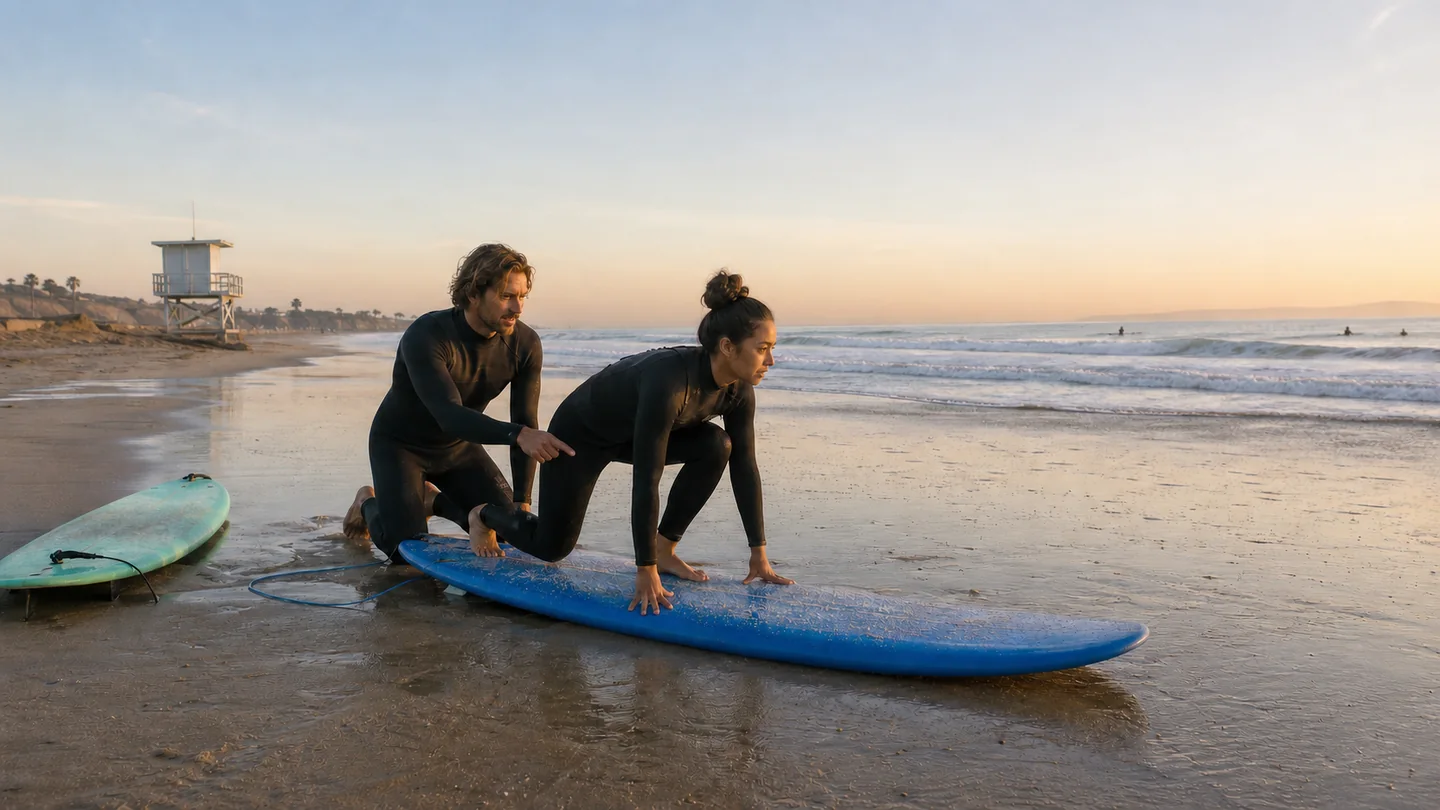
Find a balanced prone position
Paddle without the nose plowing or the tail dragging, then practice looking forward without arching until the board stalls.
- 3
Catch broken waves lying down
Learn the feeling of matching the foam and riding straight before adding the stand-up movement.
- 4
Build one quiet pop-up
Place hands beneath the chest, bring feet under the hips, and land low with eyes forward. Avoid climbing up knee by knee unless an instructor adapts the movement for you.
- 5
Exit with energy in reserve
Choose a landmark and leave before shivering, slow reactions, repeated missed waves, or a worsening crowd makes the decision for you.
Take a lesson at a beach that welcomes beginners
Surf schools do more than demonstrate a pop-up. A good instructor chooses an appropriate part of the beach, fits the board and wetsuit, explains boundaries, manages spacing, and watches the water while the student concentrates on one movement. Outdoor Outreach's instructor manual begins with ground school for a reason: equipment, communication, hazards, and etiquette come before wave count.
Look for lifeguards, a forgiving sand bottom, small broken waves, a manageable crowd, and a clearly defined practice zone. Read the National Weather Service beach forecast and rip-current outlook, then speak with the lifeguard about the safest area. Forecast risk is not a promise that one visible patch of water is safe.
Watch the beach long enough to see it change
From a higher viewpoint, identify where waves are breaking consistently, where water appears to move seaward, where boards are entering and exiting, and where swimmers have gathered. Rip currents can appear as darker or choppier gaps, breaks in the wave pattern, or channels carrying foam and debris offshore, but visual clues are imperfect. Ask a lifeguard rather than betting the session on pattern recognition.
The NWS calls the hazard a rip current, not a rip tide. If caught, conserve energy, float, signal for help, and move parallel to shore or toward breaking waves when able rather than fighting straight against the current. Never enter for an untrained rescue; alert a lifeguard and throw flotation if available.
The board should make practice easier
A stable, high-volume board gives a beginner more chances to feel trim, catch foam, and stand. The National Surf Schools & Instructors Association frames beginner progress as a sequence of teachable skills, not a race toward a smaller board. Rent from a local school until the learner knows what size, volume, construction, and fin arrangement suit the local break and their own body.
Check the deck, fins, leash plug, cord, swivels, rail saver, and cuff. Apply traction, secure the leash according to instruction, and carry the board without pointing the fins into people. In the shallows, never place the board between the body and an incoming wave; even a soft-top carries force.
Whitewater is a classroom, not a consolation prize
Practice prone balance, efficient paddling, looking forward, and catching broken waves straight toward shore. Once that feels repeatable, add the pop-up practiced on sand. Eyes lead the body: looking at feet often folds the rider forward, while looking where the board should travel supports a quieter stance.
After a fall, cover the head, allow a moment for the board to settle, surface with an arm raised, and locate board, shore, and other surfers before grabbing the leash. Follow the instructor's method for the local depth and bottom. Do not dive headfirst into unknown water, and do not rely on the leash to pull the body to safety.
Etiquette prevents collisions before it earns respect
Keep generous distance in the practice area. Do not launch the board toward shore when someone is in front, and do not paddle directly through a rider's path. In an established lineup, the surfer nearest the breaking part of the wave generally has priority, but beginners should learn the local approach from an instructor before joining it.
Hold onto the board when safe, communicate clearly, apologize quickly after a mistake, and move out of crowded takeoff zones while resting. Skill is not just standing. It is controlling equipment around other people and recognizing when the conditions exceed the session's plan.
End the session while the last ride is still good
Cold, sun, and repeated paddling change coordination. Finish before shivering, cramps, slow pop-ups, or frustration becomes the signal. Use a known exit, keep watching shore while approaching, and protect feet from fins without standing early over shallow reef or uneven rock.
Rinse rented or personal gear as directed, dry it out of damaging heat, and note one specific lesson: board position was too far forward, the takeoff was late, or eyes dropped during the pop-up. That observation gives the next lesson a starting point. Watching advanced surfers online cannot replace supervised practice in the water you are actually entering.
- Choose a lifeguarded beginner area and ask where to enter before putting the leash on.
- Surf with a buddy and keep each other in sight.
- Treat rip-current and high-surf statements as trip-changing information.
- Stop early when temperature, fatigue, crowding, or wave size moves beyond the lesson plan.