The First Day at the Helm
A practical first-day boating lesson: prepare the crew, control the boat at idle speed, work lines and fenders, read wind and current, and finish with a useful debrief.
Pack With A Reason
Equipment That Earns Its Place
Learn In Order
Five Skills Worth Practicing
- 1
Point, pause, then shift
At idle in clear water, feel what happens when the control moves from neutral to ahead and back to neutral. Pause in neutral before selecting reverse.
- 2
Learn the boat's turning behavior
Use a floating reference in open water, never a navigation aid, and observe pivot, windage, prop walk, and stopping distance.
- 3
Approach at a speed you can abandon
Choose the slowest speed that maintains control and state the escape plan before entering a narrow slip or fuel dock.
- 4
Give one crew member one job
Name the line, cleat, and moment. Avoid a chorus of last-second instructions, and never ask anyone to use hands or feet as fenders.
- 5
Debrief while the details are fresh
Note which approach worked, which line was too short, what moved underway, and what weather cue should have changed the plan sooner.
Make the first trip smaller
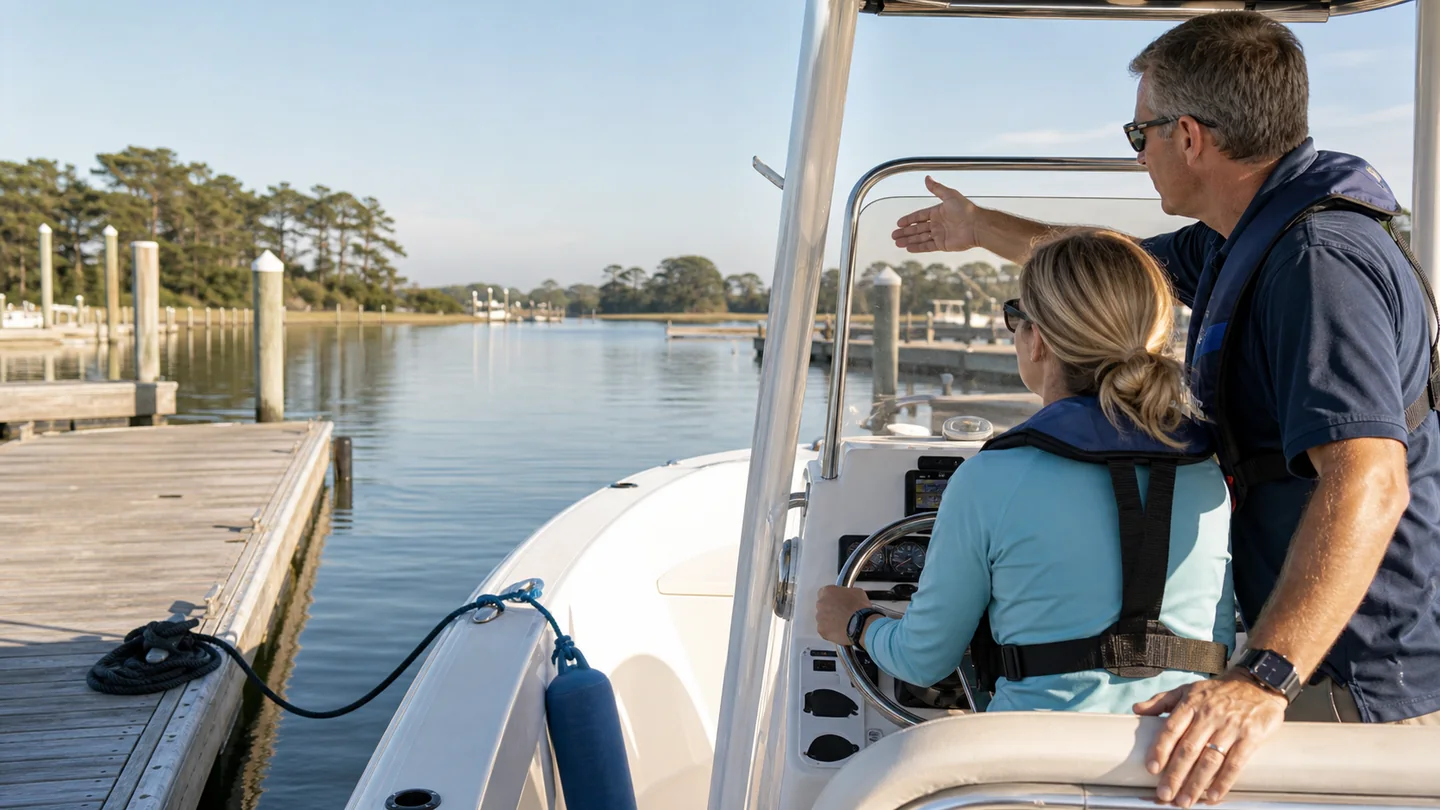
A new operator does not need a destination on day one. BoatUS and Discover Boating both steer beginners toward education, local knowledge, and practice. A quiet session near the home dock—with an experienced operator or instructor aboard—creates more useful repetitions than a busy cruise with a schedule to keep.
Choose daylight, settled weather, familiar water, and a low-traffic window. Check the National Weather Service marine forecast and active headlines, then look at recent observations without assuming one sheltered sensor represents the route. Establish a return threshold for wind, visibility, waves, fuel, and crew comfort before the boat leaves the slip.
Walk the boat from bow to stern
Find the life jackets, throwable device, fire extinguishers, sound signal, visual distress signals, first-aid kit, battery switches, bilge pump, seacocks, fuel shutoff, anchor, and radio. The federal list varies by boat and waters, so use the current Coast Guard guide and applicable state rules rather than treating this paragraph as a checklist.
Show the crew how to stop the engine and point out places where hands, hair, loose clothing, and lines must stay clear. Check that hatches are closed, the drain plug and ventilation routine are correct for the boat, fenders and lines are arranged, and loose objects cannot roll under the controls.
Brief the people, not just the equipment
Give the boat's name or description, the day's small route, and the location of safety gear. Explain how to call for help on VHF Channel 16, how to state position, and what to do if the operator falls overboard. Leave a float plan with someone ashore who understands when and whom to call if the boat is overdue.
For docking, assign one person the first line and point to the exact cleat. Agree that no one jumps, wraps line around a hand, or puts a body between boat and dock. The operator can go around; the crew should hear that before an imperfect approach becomes an emergency in their minds.
There are no brakes, but neutral buys thinking time
Practice shifting at idle in clear water. Notice the delay between control input and boat response, how the bow falls away in wind, and how much distance remains after returning to neutral. BoatUS safety instruction emphasizes navigation rules and maneuvering because these basic responses shape every meeting, crossing, and docking decision.
Use short applications of power rather than carrying unnecessary speed into the dock. Wind and current should be part of the approach plan, not discovered at the piling. If the angle or speed is wrong, return to open water early and try again. A go-around is ordinary seamanship.
Lines work best when every line has one job
BoatUS Editors describe bow, stern, breast, and spring lines as distinct controls, not decorative rope. Prepare the useful lines on the correct side before entering the fairway. Keep bitter ends aboard and lines away from propellers. A spring line can limit fore-and-aft movement while the operator uses gentle thrust, but practice that technique with an instructor before trying it beside neighboring boats.
A tidy line can run free without trapping a foot. Coil or flake excess where it will not wash overboard, chafe, or jam a locker. After docking, adjust fenders for the actual dock geometry and leave enough scope for the local tidal range without letting the boat reach pilings, ladders, or its neighbor.
Finish the lesson before fatigue writes it for you
Return while everyone still has attention to spare. Recheck the forecast and observations before the return leg, slow down for traffic and no-wake areas, and let the crew know the docking sequence early. Once secured, shut down according to the vessel procedure and check bilges, fuel, batteries, shore power, and lines as applicable.
The best debrief is concrete: the port approach was easier because the wind held the bow off; the stern line was hard to reach; the handheld radio battery was low; one locker latch opened underway. Fix those details before adding distance. Formal boater education and hands-on instruction remain the next step, not something this article replaces.
- Take the state-required boating course and add on-water instruction for the actual boat.
- Wear the engine cut-off device where required and whenever the operating setup calls for it.
- Never let schedule pressure overrule a warning, poor visibility, or an uncomfortable crew.
- Treat fuel, weather, daylight, and operator attention as reserves, not targets to exhaust.