Crabbing Without the Dockside Scramble
How to choose a lawful ring, trap, or pot; rig it without creating a navigation hazard; retrieve it cleanly; and sort crab with the right gauge ready.
Pack With A Reason
Equipment That Earns Its Place
Learn In Order
Five Skills Worth Practicing
- 1
Rig on land
Connect bait, line, required escape device, buoy, and owner markings at home, then pull against every connection.
- 2
Flake line before deployment
Lay line so it can run without knots or feet inside the coil. Keep every person clear as the gear descends.
- 3
Retrieve at a steady rate
Keep tension so crab do not spill from a ring, but do not wrap line around a hand or body.
- 4
Sort in a fixed order
Identify species, sex where regulated, shell condition, and legal measurement, then release anything uncertain immediately.
- 5
Log the set
Record location, depth, tide stage, soak, bait, and result so the next choice comes from evidence rather than dock talk.
Start with the rulebook, because crab fisheries are local
Dungeness rules in Washington and Oregon are not blue-crab rules in Maryland. Legal sex, size, shell condition, season, daily limit, reporting, bait, gear count, buoy marking, turtle-reduction devices, and hours can change by species and jurisdiction. Open the official agency page for the exact water on the day of the trip.
The regional differences are part of the activity, not fine print. Maryland DNR describes hand lines, rings, traps, trotlines, and dip nets for blue crab. Washington and Oregon agencies devote extensive guidance to rings and pots for Dungeness and other species. Borrow the method from a local expert; do not carry the limit or measuring technique across a state line.
Choose gear that fits both access and attention
From a pier, a ring or collapsible trap can be watched and retrieved without a boat. Oregon's guide notes that rings are generally checked much more frequently than pots because crab can leave when the ring lies flat. A pot can fish through a longer soak, but it needs correct doors, escape openings, line, buoy, and loss-prevention rigging.
Before leaving home, inspect mesh, fasteners, bait latch, harness, line, buoy, owner identification, and any required degradable escape cord. WDFW's coastal guide specifically calls attention to gear condition and correct setup. A lost pot continues to cost animals and other boaters after the trip is over.
Keep line out of the two places it causes trouble
On a pier, those places are ankles and neighboring fishing lines. On a boat, add the propeller and navigation channel. Flake the line into a clean container before setting. Never stand inside a coil, never wrap a hauling line around a hand, and stop the operation if loose line reaches the cockpit sole near a running propeller.
Use enough scope and lawful line for the maximum water depth during the soak, not just the depth at deployment. Place gear outside traffic and prohibited areas, account for tide and current, and record the position. Washington advises weighted or sinking line in relevant settings and a buoy system visible at the surface; exact requirements must come from the current local rule.
Bait is less important than a closed bait box
Agency how-to guides commonly recommend fresh, oily fish or other locally legal bait. Secure it in a bag or container that allows scent to disperse without giving the first crab an easy meal. Check bait restrictions and avoid moving fish waste or invasive species in ways local rules prohibit.
Lower gear under control; do not throw a loose coil and heavy frame together. Mark the set time and tide stage. Soak advice varies by gear and place, so use the local agency's technique as a starting point, then log what happens. One result does not prove a magic bait or location.
The lift and sort should be one calm sequence
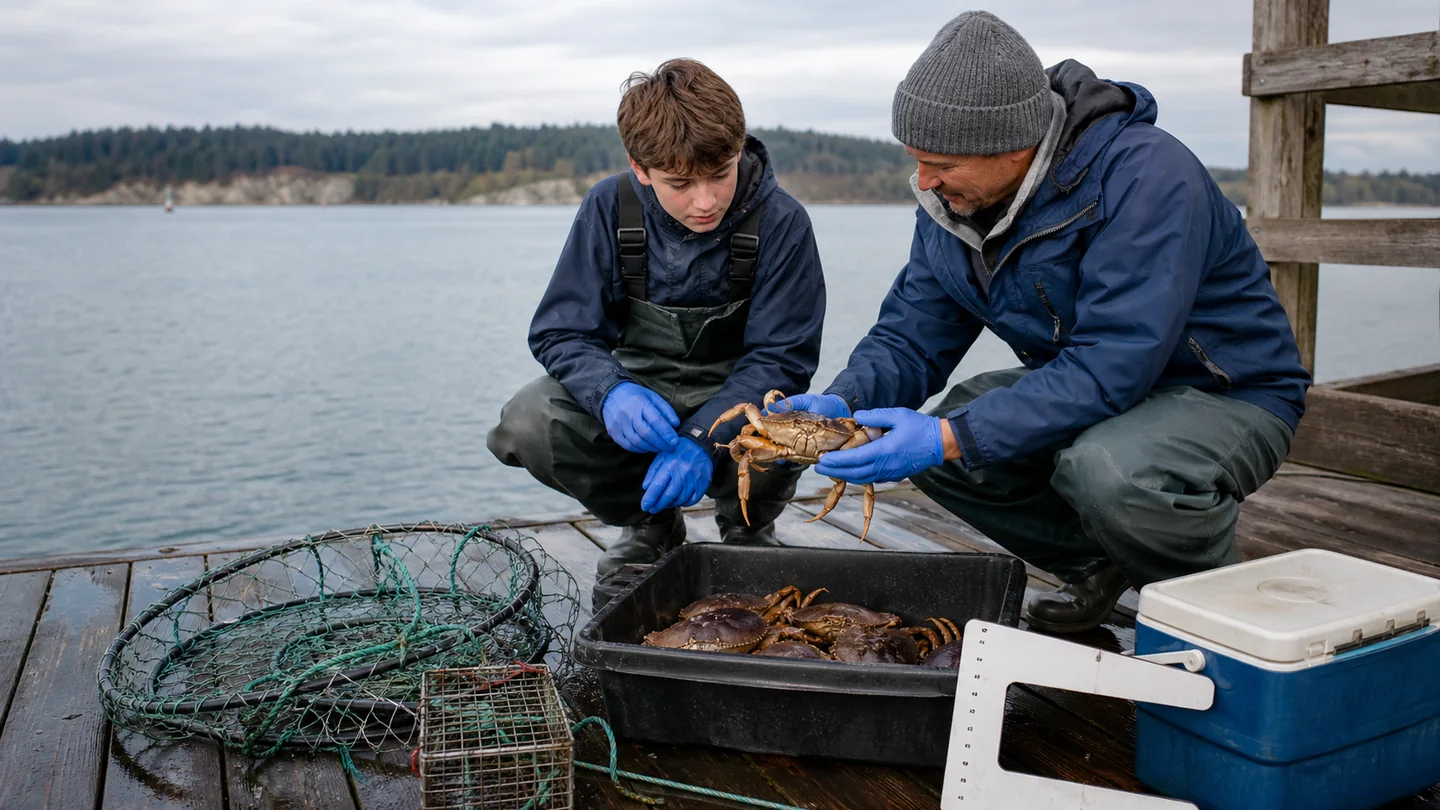
Retrieve smoothly and keep a ring level. Bring a pot aboard where it cannot slide back, then keep hands away from the opening until the frame is stable. Handle a crab from the rear of the shell or with appropriate tongs, never by testing whether the claws can reach a fingertip.
Have the gauge in hand before sorting. Identify species, check any sex or shell-condition rule, and measure exactly where the agency diagram shows. Oregon and Washington both emphasize quick sorting and gentle release. Return undersized, prohibited, soft-shell, female, or otherwise unlawful crab immediately when the local rule requires it; do not leave the uncertain pile to the end.
A clean finish protects the next trip
Record retained catch as required and keep it cool using the lawful method for that fishery. Count again before leaving. Retrieve every line, bait container, and piece of gear, and report lost commercial or recreational gear where the local agency provides a system.
Rinse and dry gear, replace abraded line and corroded clips, and reinstall degradable cord rather than substituting permanent material. The useful lesson may be that the pot walked, the ring emptied during a slow lift, or the site became crowded at a certain tide. Those observations improve both catch and safety without turning a single afternoon into folklore.
- Use only the official species, area, season, gear, limit, and reporting rules for the water being fished.
- Keep pots and lines out of navigation channels, ferry routes, swimming areas, and prohibited zones.
- Prepare the gauge and release technique before gear is retrieved.
- Never leave a soak unattended beyond what conditions, law, and safe recovery allow.