Shrimping Is More Than One Fishery
A regional field guide to pot shrimping from a boat and cast-, dip-, or push-net shrimping near shore, with the equipment and teamwork each method demands.
Pack With A Reason
Equipment That Earns Its Place
Learn In Order
Five Skills Worth Practicing
- 1
Name the regional method
Write down the official area, species, opening, permitted gear, limit, and reporting method before packing.
- 2
Rehearse line or net handling on land
Flake the full pot line or practice the cast in open space until no one is standing in a loop or release path.
- 3
Give each person one role
For a pot set, assign helm, pot, and line. For baiting, agree who holds boat position and who throws before approaching the poles.
- 4
Sort immediately
Identify the catch, return prohibited bycatch, apply the current limit, and cool retained shrimp without a growing deck pile.
- 5
Make the second set from notes
Record depth, tide stage, current, gear behavior, soak or drift, and catch so the adjustment has a reason.
First decide which shrimping world you are entering
Washington's recreational spot-shrimp fisheries are strongly associated with pots, deep water, vessel handling, buoy systems, and tightly managed openings. Florida FWC lists several net methods for its recreational shrimp fishery. South Carolina DNR's Pete Laurie tells a distinctly local story of bait poles, cast nets, and two people working a boat together. These sources are not interchangeable how-to cards; they show why local knowledge comes first.
Open the official agency page and write down the area, species, legal dates and hours, license or permit, gear definition, mesh or size rule, limit, bycatch rule, marking, and reporting requirement. Check emergency changes again immediately before departure. A saved article from last season is background, not authority.
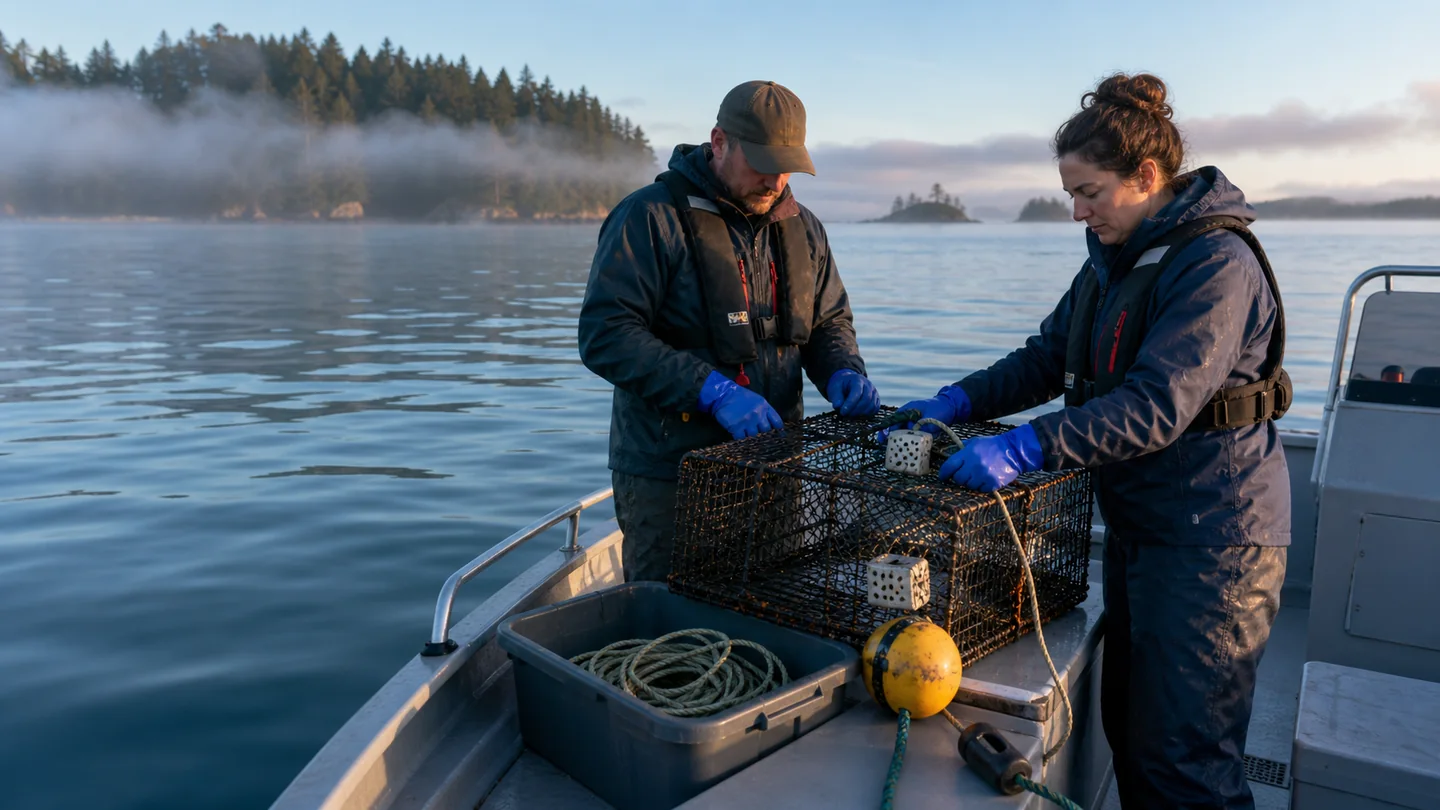
Pot shrimping is a line-management and boat-control job
A pot setup includes the pot, bait container, harness, required escape mechanism, enough lawful line for the maximum depth during the soak, weights or sinking section where required, and a correctly marked buoy. WDFW's gear rules are unusually specific because each part affects catch, gear loss, navigation, and long-term entrapment if the pot is lost.
Rig and test connections ashore. Flake line into a tub so it pays out without knots, with no one inside a loop. At the set, the helm maintains safe position while the gear handler controls the pot and a separate person manages line if crew size permits. Never let a running propeller and loose line occupy the same workspace.
Retrieval starts before the buoy comes alongside
Approach from a direction that lets the helm keep the buoy in view and reduces the chance of driving over the line. Discuss which side will recover, where the pot will land, and what happens if the first pickup misses. Keep hands, clothing, and hair clear of a mechanical puller and never wrap loaded line around the body.
A deep pot can be a serious lifting load even before catch and current add to it. Use equipment and crew appropriate to the boat, train on an empty system, and stop if sea state makes the deck operation unstable. Once aboard, secure the pot before opening it, sort promptly, release bycatch, apply the current limit, and cool retained shrimp.
Net shrimping rewards timing and a repeatable throw
Florida allows several recreational net types under rules that must be checked for the location and season. A cast net only helps when the operator can open it over the target without endangering a passenger, railing, light, or neighboring boat. Practice on open ground, learn a safe method suited to the net, and choose a size the operator can throw repeatedly without strain.
Laurie's South Carolina account is valuable because it admits the human part: throwing is learned, boat position matters, and a partner can make the sequence work. In a bait-pole fishery, the person at the helm and the person with the net need the same plan for approach, drift, and abort. Local permit, bait, pole, season, and net rules remain controlling.
The catch table should never become a mystery pile
Keep a sorting tub, current rule summary, measuring tool where applicable, gloves, and cold storage ready. Identify unfamiliar animals before retaining them and return prohibited bycatch with as little handling as practical. Do not assume every shrimp-like animal belongs to the same limit or that one state's possession rule follows the boat home across a boundary.
Record the catch as the fishery requires. Clean the work area before the next set so loose line, shells, bait, and gear do not accumulate underfoot. The safest rhythm is set, secure, sort, record, cool, and reset—not a fast cycle that postpones every careful job.
Good notes beat a crowded-ramp rumor
For pots, record position, depth, tide stage, current, soak, bait, and whether the pot moved. For nets, note time, water movement, clarity, light, boat approach, and how consistently the net opened. Do not publish sensitive locations or obstruct other users simply because one pass was productive.
Afterward, rinse and dry nets, inspect mesh and handline, replace chafed pot line, renew required escape materials, and check the buoy markings. Report lost gear where the agency provides a process. A trip that recovers every piece of equipment and produces one clear lesson is a solid trip, even when the cooler is light.
- Check same-day agency notices; some shrimp openings are brief or adjusted in season.
- Keep the propeller stopped or safely separated whenever loose line is in the recovery zone.
- Practice casts and pot-puller operation before adding current, darkness, or a crowded deck.
- Treat limits, mesh, gear marking, and methods as jurisdiction-specific facts.